CRM for E-commerce and Marketplaces: How to Choose the Right One?
Looking for a CRM for your online store? Learn how to choose a CRM system for marketplaces, avoid mistakes, and scale your online business with Geniustudio.
“The Best CRM” Does Not Exist
Trying to find a CRM system specifically for your business, you will inevitably encounter search results like “TOP 10 CRM Systems” and similar comparisons, although there is no such thing as a “good” or “bad” CRM system. There are only those CRMs that suit or do not suit specific business needs.
What is a CRM System and Why Does an Online Store Need It?
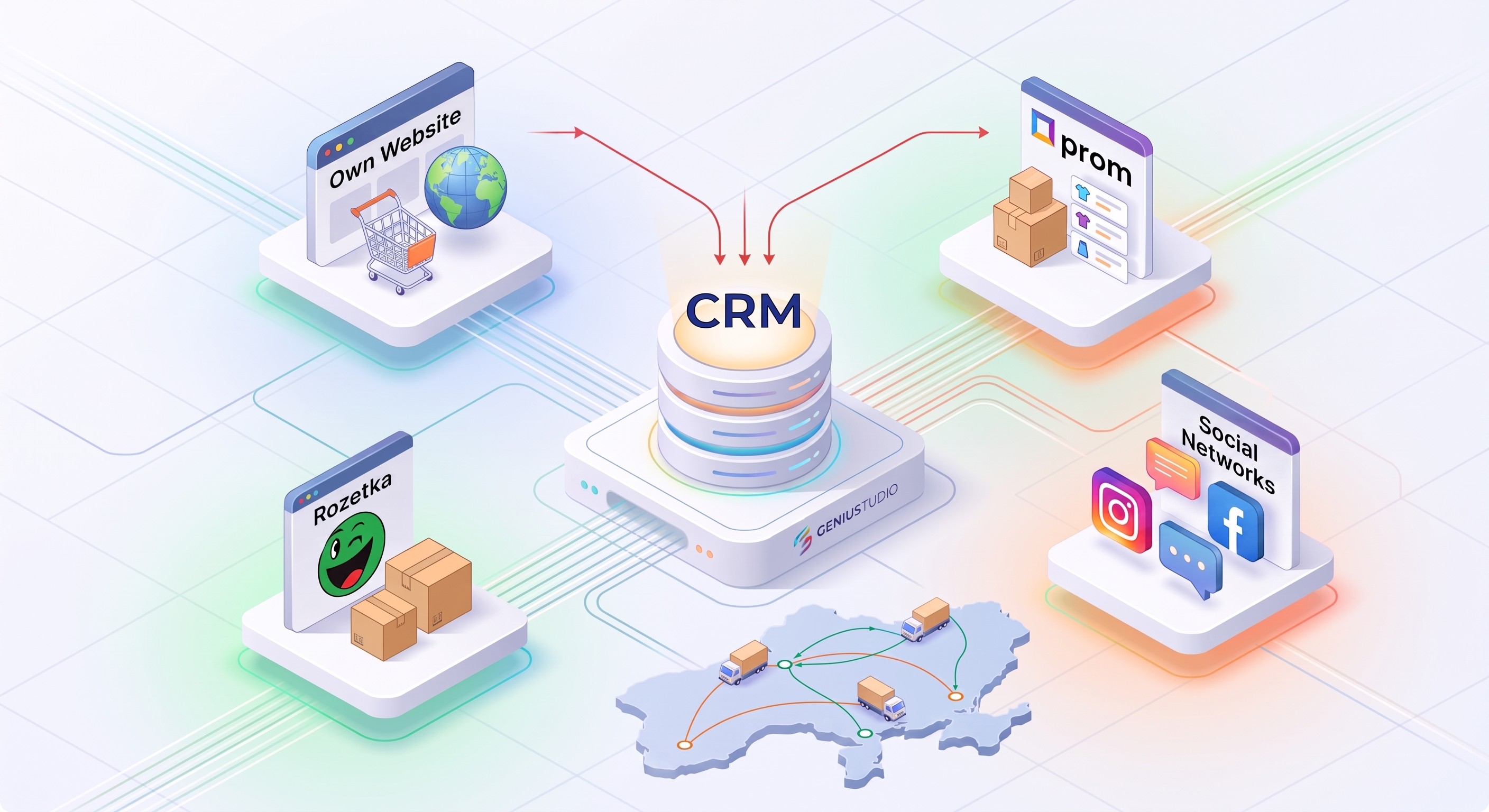
A CRM for an online store – is an essential tool for e-commerce. It provides flexibility in maintaining customer communication, processing orders, and building logistics. It makes it possible to manage product inventory through additional modules and integrations. Overall, it keeps everything in one place just a few clicks away.
A CRM system helps collect customer data, forming a picture of their preferences and needs, which can later be used to create a personalized offer. The collected data will help better understand trends and build a future strategy.
A CRM with appropriate integrations allows you to combine sales on platforms like Prom and Rozetka, or on social networks like Instagram.
It is also a good tool for automating routine tasks – order statuses, supplier/manager workflows, reporting, and other systematic work.
Choosing a CRM System for a Specific Case
Here, it is necessary to understand the needs and capabilities of the business. You should ask yourself the following questions:
Are you operating through a single sales channel?
In this case, the main thing – is to determine the basic scope of functions and avoid overloading yourself with unnecessary features. If you work with a single channel, there is no need to build complex integration systems with other marketplaces. It is enough for the CRM to be able to view and process orders, maintain a customer base, and track interaction history. Also, through appropriate integrations, the function of automating delivery logic, payment, and feedback remains.
For example, let's look at SalesDrive – this CRM helps distribute orders between managers and process them promptly, integrate delivery services, generate tracking numbers “out of the box,” use various formats of communication with customers, etc. This is a practical option for managing a single sales channel.
At the same time, for such a business model, you should not look for systems that support working with a larger number of sales channels and customization capabilities. As a result, there is a risk of overpaying for features that will most likely not be needed.
Are you operating your own website and third-party marketplaces?
In this case, in addition to the specifics of your own website, you must consider the rules for presenting information on other platforms. For example, Rozetka, Epicenter, or Prom have their own requirements for publishing products. Therefore, your marketplace CRM must have appropriate integrations that allow you to collect orders from all platforms in one place, and synchronize inventory, prices, and delivery terms depending on the marketplace.
A positive example here is keyCRM – it pulls orders from third-party marketplaces and your own store while synchronizing inventory, order statuses, delivery, or payment. It integrates with marketplaces such as Rozetka, Epicenter, Prom, etc. That is, it is a suitable option when you need to bring all sales sources under one «hood”.
Nevertheless, if keyCRM does not have a ready-made integration with the platforms a specific business works with, you will have to set up a custom integration via API or transfer part of the information manually.
When you operate a large e-commerce project?
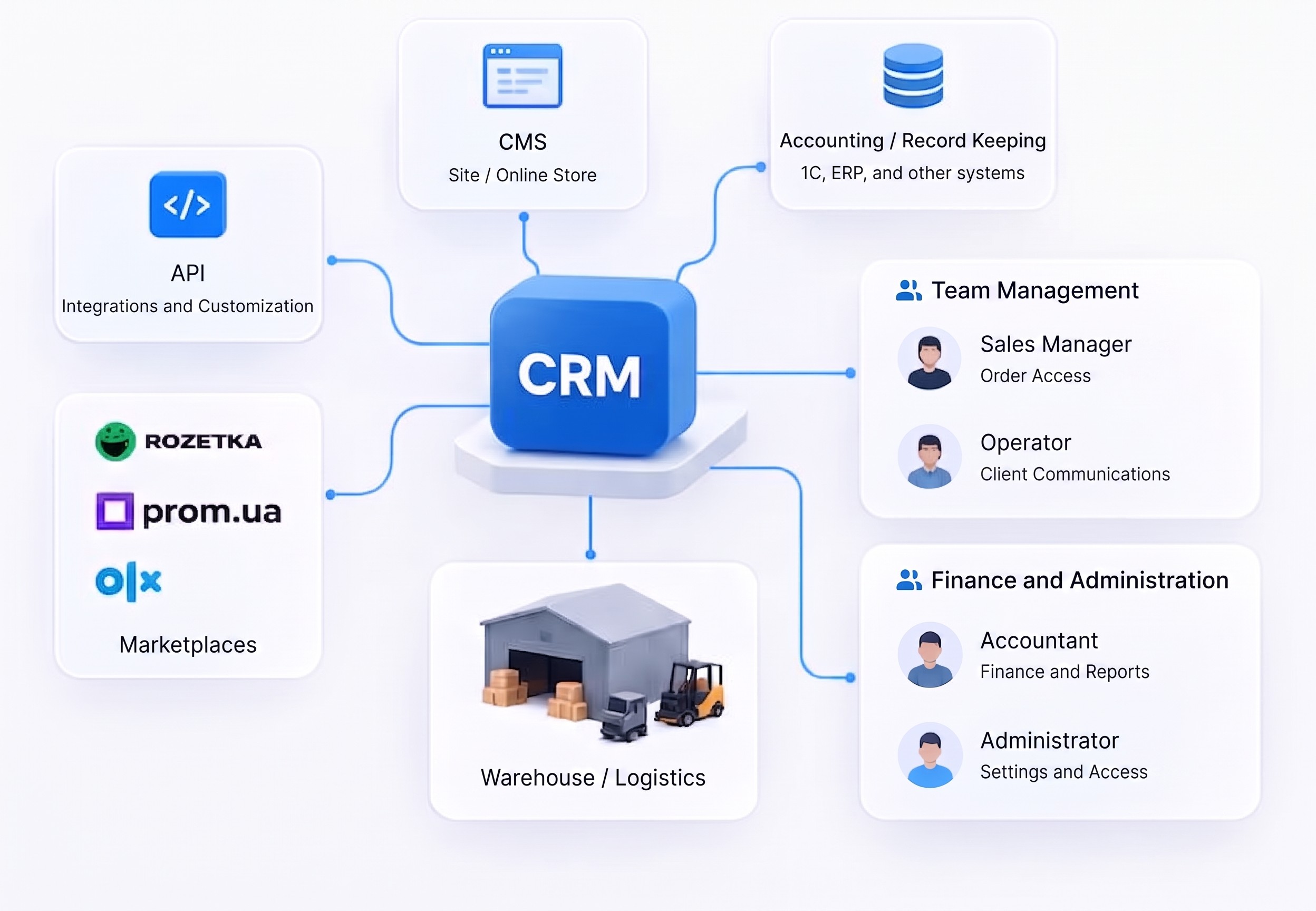
In this case, it is necessary to consider the complexity of your architecture, particularly in the interaction of CRM, CMS, and accounting systems. Therefore, it is important to design the integration architecture and data exchange between systems via API.
Furthermore, as the number of products, platforms, and employees increases, new requirements for CRM naturally arise. The need to restrict access rights – emerges. For example, a sales manager needs a completely different set of functions than, say, an accountant. At the same time, ready-made CRM systems may not always support specific business processes right “out of the box,” requiring additional settings and integrations. You can learn more about working with a large online store in our article.
A positive case can be KeepinCRM. It supports a large set of ready-made integrations, as well as an API that allows building integrations for specific business requests. This is a strong argument for large projects where the CRM must interact with marketplaces, accounting systems, and other infrastructure elements.
Even with a wide range of integrations, customization capabilities may prove insufficient during further scaling. As the scope expands, additional refinement will inevitably be needed. This is a prime example of where Geniustudio can step in and help with CRM refinement or the implementation of required integrations.
Most Common Mistakes When Choosing CRM Systems
Mismatch with business scale:
Trying to build a complex sales system without considering necessary integrations, sales funnel logic, customer communication, and employee hierarchy.
And conversely, purchasing/developing CRM systems with redundant functionality that turns out to be unnecessary. As a result – the budget is spent inappropriately.
Developing/purchasing a CRM system without a clear vision:
Another mistake – is developing or purchasing a ready-made system under the influence of advertising. Hence, as mentioned at the beginning, one of the dangers of materials headlined “TOP 10 CRM Systems” arises. You should choose a CRM system only after a clear understanding of your business needs.
P.S. We have prepared several tips that will help you better understand your own business.
Inability to scale further:
The last point follows from the first two. An incorrectly configured CRM system from the very beginning will create problems for the further scaling of business, features, and capabilities, which is why every subsequent system expansion will cost more.
Conclusion
A CRM for an online store should not be chosen solely based on “TOP-10” ratings, but only on the results of analyzing the needs and capabilities of your business. Also, do not forget about potential expansion and how well you can automate processes and eliminate manual work. Don't know where to start? Geniustudio is ready to help!